• Portfolio
  • The Ritual // BuJo
  • Workshops
  • ITP Blog
  • Idea Compost
  • Resume
  • Bio/Contact

J. August Luhrs

  • Portfolio
  • The Ritual // BuJo
  • Workshops
  • ITP Blog
  • Idea Compost
  • Resume
  • Bio/Contact

Design for Discomfort Final: Winter Show Performance of Rhythm 0.0.2

Since I don’t have documentation of my future performances yet, here is a placeholder with the notes I had before/after the last class. I’ll update the blog with my performance videos later next week!

Brainstorm // Questions for Class:

  • Commands

    • major issue — how to deal with the queue?

    • Should I have a queue of commands, one per user button press, or should I do a timed voting round, where every 20 seconds the command with the most votes gets pushed to the screen?

      • main consideration — much more emphasis on the group than the individual

      • could have running vote counts on display(top 3), to give voters a sense of urgency/pool votes

      • how does that play into the idea that some commands are continuous and some are one-off actions? doing 20 seconds of push ups is way different from eating a cookie for 20 seconds.

        • could have different round timers per action type?

      • is 20 seconds too long or too short? I just can’t imagine setting up the face shocker in any less than 10 seconds, but if 20 seconds, that’s only 180 commands per hour… I mean I guess that could still be a lot since I’ll do at least 360 commands, and depending on what that is, that’s a fucking lot…. if 15 seconds per round, that’s 240 per hour, potentially 960 commands per day… hmm. that’s a lot of cookies.

  • Space

    • 6x6’ space presumably

    • display screen back and to stage left/right (opposite table?)

    • table to side next to other project (sandwiching me between table and wall), where I place all props and the performer screen interface

    • do I need poster with instructions? or is url on display screen enough?

    • laptop on table for live streaming / screen capture

    • other camera in space for documentation?

  • Entrance Design

    • need to design so as to not need any direct audience guidance

    • Website

      • simple url landing page

      • intro and waiver

        • what do I say // how do I frame?

        • “From the next page, you will be able to press buttons to (vote/send) commands to my screen, which I will then perform.”

        • “Your input is totally anonymous, and I will not know who is sending me what command. Even if you are the only person standing here, someone across the country could have the app open, since I am also live-streaming this.”

        • “I have personally selected these options, but it is up to you to decide which I perform” (some sort of responsibility check?)

          • might stifle input

        • There is no personal log in, so personal statistics will reset if you exit the page

      • could have email input? for mailing list // sending them stats page of total commands over the Y minutes

  • App Design

    • just buttons?

    • menus of different categories? (muscles, mouth, skin, hands)

    • should I have personal stats page?

      • could be per press, stats like (% of other users have pressed that, I’ve done that X times already — for X seconds)

      • or could be at end, sending them what they’ve done over time

    • could have page you could click to to look at overall stats // your stats?

  • Display

    • time elapsed

    • current command

    • voting counts per round?

    • stats overall

  • Performer app

    • display current command so I don’t have to turn to screen

    • add/drop buttons

      • to remove or add options on the fly

    • pee break button, will send pause screen to all other screens

  • Assistant

    • needed?

    • could guide if users are confused

    • could run to get resupplies? fill water, etc.

  • Pivots

    • audience change places? not sure it makes sense

  • To Do

    • Stress Test

    • replace batteries of shocker

    • Any other interactions?

    • bring change of clothes

    • should have puke bucket on hand?

    • get cookies

Notes from Class Feedback:

  • Anonymity abstraction

  • Okay that user doesn’t feel responsible, that’s the point — regardless of how they feel, the result on me is the same (unless their feeling would adjust behavior)

  • Main questions

    • Space — user guide

      • Url on screen enough?

    • Queue or voting rounds

    • Statistics

    • Assistant needed?

    • Other interactions

      • Switching with audience

  • Present

    • Space guide

      • Explain process

      • Commands

    • Original Idea — perform today

    • Pivot — voting rounds

  • User space

    • More obvious the better, do as much signage as possible

    • Project space with projector \

    • Right above head

    • QR Code?

    • Block out space w/ tape

  • Pivot

    • No spam in code

    • Long queue

    • Prerecording?

      • Maybe a delay video projection

    • Assistant

  • Maybe just no spam

  • Could just cut the longer actions

    • Frenetic

    • More like an impressionsit painting

    • Button physical to skip to next command

  • Stats are totally secondary, don’t even think about them yet

  • SOUND feedback

    • Speaker?

  • Business cards

categories: Designing for Discomfort
Wednesday 12.12.18
Posted by August Luhrs
 

Designing for Discomfort: Reading Response #5

  • Jordan Wolfson’s Violence VR

    • wow, that’s hardcore

    • the focus on passivity was an interesting choice. i wonder what it would be like if participants had the option to move their avatar closer/farther away, it seems especially cruel to make the user cemented in place as if paralyzed. though, would it be crueler to make them seemingly have the option to stop the violence by moving between the aggressor and victim, but in reality there’s nothing they can do to stop it, no matter how hard they try?

    • hmm the metal bars are a curious touch, seems strange to focus on that when the bars aren’t a part of the scene

    • the instagram video of the person’s face as the scene unfolds is so unsettling

    • yeah, I wonder how this piece would be perceived if it had a pop-up show at a trump rally…. so scary.

    • i don’t know if i agree with the conclusion — i don’t think it’s possible to have violence without context. I don’t think it’s possible to have anything without context.

  • Nietzsche Brain Pickings — Embracing Difficulty

    • reminds me of Brene Brown’s stuff on vulnerability, which I love

    • A professor I had at a poetry workshop in Paris told me the best thing once: the best gift you can give a writer is a broken heart

    • totally agree that hardship and joy operate in an osmotic relationship. I once wrote an essay referencing a part of Khalil Gibran’s The Prophet, where the core concept was that our sorrow carves the cup of our soul deeper, for it to hold that much more joy. A teacher of mine in high school once compared it to a ruler in a mirror, the more you try and diminish the amount of one, the more the other diminishes. I think you see that a lot in people with depression, they’re either someone you think of publicly as the happiest person in the room (and then they kill themselves), or their depression is more of a total numbing to emotion.

    • I actually have a lot of feelings on this concept haha, which is why I was so interested in taking this class in the first place. A tattoo I want to give myself one day is a quote from Pema Chodron that fits nicely with all this — It is only by exposing ourselves over and over to annihilation that that which is indestructible can be found within us.

categories: Designing for Discomfort
Wednesday 12.05.18
Posted by August Luhrs
 

Designing for Discomfort Week 11 pt. 2: Rhythm 0.0.2 (Final Project Proposal)

Rhythm 0.0.2

Final Project Proposal

For my final project, I’ve decided to build from one of the previous challenges and do another iteration of my performance art piece Rhythm 0.0. I outlined my idea for complete fruition of this piece in my previous blog post for Rhythm 0.0.1, so I’ll just go over my goals and plans for this specific prototype.

Summary

Rhythm 0.0.2 is a performance where I will occupy a room on the ITP floor for at least two hours while onlookers can anonymously send me commands over their phone for me to perform. The audience will be within eyesight of me, but hopefully there will be enough people on their phones that I won’t be able to tell who is sending me what. There will be a screen in the room with me, probably big and on the wall so the people can see it also and so that I can receive the prompts without having to check my phone. I might have a device on me to just highlight the commands I’ve already performed, but other than that I will probably be in constant motion, acting out the prompts. The commands will range from repetitive and physically tiring motion, to consumption of food, to removing/adding articles of clothing, to self-inflicted pain or electrical shocks, and more — running the gamut between good/bad.

User Command Options

  1. Muscles

    1. do an ab workout

    2. jump on one foot

    3. hold a handstand

    4. dab

    5. stretch

  2. Mouth

    1. eat a cookie

    2. drink water

    3. suck on a lemon

    4. deep breath

  3. Skin

    1. flog yourself

    2. shock yourself

    3. slap self in face

    4. (belly flop?)

  4. Hands

    1. paint your body

    2. juggle dildos

    3. take an article of clothing off

    4. put an article of clothing on

    5. stop performance (only unlocked after 2 hours, or if I unlock during performance)

Goals

  • I haven’t discovered the ultimate purpose/message of this piece yet, because I haven’t performed it enough. But I’m interested in the main question of: “What would Marina Abramovic’s Rhythm 0 have been like if the audience could have interacted with her body anonymously? I’m not trying to say anything profound about cruelty in chat rooms or senseless violence so much as I’m just trying to make a thought-provoking game that uses my body as the medium. It’s not very game-y right now, but in future iterations I hope to make each user a distinct player with stats, unlocks, and rewards. Further than that though, I hope to explore something I think about every time I make interactive art — audience agency. I want to know what people feel when they realize my body is at their fingertips — whether it makes them feel powerful or powerless or neither.

  • I also want to explore what effect this power or lackthereof has on the user, especially in circumstances where they choose something painful or hard for me to do. My second performance art piece ever included me and one of my best friends branding my chest with red-hot metal on stage, and I always say that it hurt him more than it hurt me. Was it cruel of me to ask my friend to torture me? Will my audience for this piece resent me for making them feel complicit in my pain?

  • Stats page? Will hopefully have some sort of data display in the room or on the app where people can see a graph of some sort counting how times I’ve done each action (sent from my device?) Originally this was to display a “red vs blue” style team tug-of-war where the actions would be categorized as either good or bad and users would see which type of action was “winning” overall.

  • I will hopefully get feedback from a comment box or text input on the website, to hear what people’s thoughts are and if they have any other ideas for commands. In 0.0.1 there was an option for people to write out their own commands but I think it led to the opposite-intended effect where people were reluctant to put any commands because they wanted to put something clever.

User Personas

  1. Role-based

    1. Many users of this playtest will simply be playing the role of a supportive friend, and will want to interact minimally and only enough to make them feel like they are helping my art (usually something positive, unless they are a good friend, then they will do the extreme ones — I’ve found that only your best friends love you enough to be cruel to you).

    2. Some will take the role of stress-tester / troll and will delight in pushing me and my piece to its limits. I was hoping for some of these people in my first playtest, but no one opted to choose hyper-repetitive actions.

    3. I wonder if anyone will take the role of protector and feel bad enough to try and skew the actions towards good ones or at least ones that are easier for me to perform.

User Journey

  1. User encounters me in the room, or a crowd watching me in the room.

  2. Either by asking someone or by seeing the big sign over the room, they see they can log onto a website to interact with me.

  3. Pulling up the website, they see a series of menus with different buttons. Each button has clear labels of what each action is.

  4. After pressing a button, they can look to the screen inside and see their action queue up behind the others.

    1. They might be annoyed at the way the queue unfolds?

  5. The rest of the experience is a feedback system of watching me and pressing buttons until either they get bored and leave or the performance ends.

Visuals

View fullsize marina.png
View fullsize 1105181325.jpg
View fullsize 45481191_1626053574368080_5597174034090426368_n.jpg
View fullsize 45487663_1566903120076491_6440469319104069632_n.jpg
categories: Designing for Discomfort
Wednesday 11.28.18
Posted by August Luhrs
 

Designing for Discomfort Week 11: Memorial

Memorial:

Death Box Quiz Thing

Since the prompt for this week’s assignment was to make a memorial that would exist in a physical location and bring attention to an important topic you feel goes under-noticed in society, I knew I wanted to make something about mortality and impermanence. Death is something I try and embrace, with my goal to be keeping a near-constant awareness of my own mortality and that of everyone around me, in order to appreciate life, keep things in perspective, and ironically, to keep things light and fun. I figured I could do a spin-off of a previous project, the Deathwatch, and make it a physical installation as opposed to a wearable, but still inspired by the same quote from G.I. Gurdjieff:

"The sole means now for the saving of the beings of the planet Earth would be to implant again into their presences a new organ … of such properties that every one of these unfortunates during the process of existence should constantly sense and be cognizant of the inevitability of his own death as well as the death of everyone upon whom his eyes or attention rests. Only such a sensation and such a cognizance can now destroy the egoism completely crystallized in them..."

So I decided to stick with the idea of giving an expiration date to the user, hopefully setting them up to think about what it would really feel like if that was the true day of their death. I wanted to sort of trick people into getting that message by having them blindly interact with a seemingly fun game only to have that twist at the end. I also thought it would be better to make something interactive and light as opposed to a memorial that was very heavy and uninviting. So the box experience was:

  1. Users see the box, buttons and display lit up, with a message “Press One”. The colors of the message (“Press” in white and “one” in green) correspond to the colors of the giant arcade buttons to the top and bottom respectively. Hopefully that’s enough leading to get them to choose and press a button.

  2. Then a random assortment of binary “this or that” questions are presented in the same color structure. There are twenty different pairs that could be displayed (“teeth/toes”, “daddy/zaddy”, “PB&J/pizza”, “3 kid/3 $$$”, etc.) and after they make 6 choices, the display reads “look below”.

  3. The display and a noise leads them to look on the front of the box, where a small receipt is being printed. Once it’s done, they rip off the paper and receive their message, which reads “Congratulations! You have: X years, Y months, and Z days left to live. What will you choose next?”

The choices are totally arbitrary, the arduino doesn’t even record which button was pushed, it only increments a countdown until they’ve made 6 choices. I wanted to get across a funny, absurd flavor for what living is like, you make all these stupid choices, and then it doesn’t really matter either way, because you’re going to die no matter what. The death-date prediction was based off the Deathwatch statistical sketch, but I adjusted the probabilities to make it skew toward sooner deaths. It’s not as interesting when 90% of the people live until they’re 81; I wanted people to really have to think, “What if this is right and I only have 9 more years left to live? What then?” Which I hope is guided by the last message of “What will you choose next?” — I usually don’t like being so overtly self-help, but I felt like the receipt was disconnected from the buttons without that last part. I was excited to be able to use a mini printer for the first time, and hopefully they can keep their forecast like a fortune cookie.

Overall, really happy with how it turned out, and excited to leave it up tomorrow during the day and see what people think of it (and their inevitable demise).

Reading Responses

  • Doris Salcedo — The Materiality of Mourning

    • I think there’s a lot to unpack with the idea of using “permanence” to demonstrate “impermanence” — or rather, using the less impermanent to call attention to the impermanent (or I guess in the abstract, the infinite… I digress.).

    • Wow, would love to see some of her concrete sculptures, they sound incredible. Giving me a lot of ideas… I should try out concrete.

    • Wow, the grass table coffins. Damn.

    • The first thing that came to mind for something that I could do in a similar vein would be to make sculptures referencing the cartel violence in Cuidad Juarez that was happening throughout my adolesence and peaked during my highschool years. So many stories coming across the border with my classmates — bodies cut up in coolers and sent to families during Christmas for “tamales”, decapitated men in women’s lingerie hanging from highway signs, and many other horrors — that lend so well to this kind of stark visual representation in a sculpture. But those aren’t my stories to tell, my family was lucky enough to not have felt any of the violence first-hand, so that’s not something I plan on pursuing. Lot to unpack there as well.

    • I think public art as direct action is something I really want to explore further and could possibly be the most important day-to-day application of art, in my opinion."

    • “Solitary making but collective art”

    • “Making by unmaking'“

    • This is really challenging me to think about how to make my art mean more. I’ve always embraced an absurdity and anti-cerebrality to my work, but perhaps I need to step out of my comfort zone and try to actually say something…respond to something… make a conversation about something…

    • It’s interesting to hear her constantly refer to these works as acts of mourning, because they are represent entire peoples and countries, whereas I’ve done a lot of work and research on very personal mourning. But it’s the same, I guess.

    • Brainstorm

      • something iterative, repetitive, using small pieces but huge

      • in a park? but how to clean up? what could remove itself but not be litter?

      • something that reminds them of their mortality

        • button you press and it just tells you you’re going to die (boring)

      • making by unmaking — self-destruction box

        • button — press me — “this box will destroy itself after 1,000 button presses. You are press number 23.”

        • or “the person who pressed the button last is now dead. You will die the next time this button is pressed. Plan accordingly.

      • shredder box

      • Harrison Bergeron box would be fun, performative

  • Sam Durant Doesn’t Need Defending

    • This is something I’ve thought about a lot as an affluent, white, male-presenting artist, so I’m eager to hear what’s presented.

    • “Protest isn’t the same as censorship: The former is done by those who lack the power to change a situation, the latter by those who have it.”

      • I’ve never heard this phrased like that, makes a lot of sense. I practice a lot of double-think when it comes to censorship, so debates like this always get me agitated haha. On the one hand, I think censorship (by power or protest) is completely antithetical to the entire purpose of art, but at the same time, I think there’s a lot of bad art — art that’s irresponsible, cruel, and/or oppressive — and we should do something to ensure that art doesn’t get much light.

    • I often think about one art drama back in Los Angeles when it comes to censorship. There was an art student in L.A., I think at UCLA, that had done a piece for their seasonal show that included a swastika; the student was Korean if I remember correctly, and their piece was using imagery from Korea’s long history, trying to do something along the lines of “getting back to their roots”. A Jewish student in the school complained (saying their grandparents were holocaust survivors and were going to attend the show or something) and after some protests and a long email debate, the school ordered the artist to remove the piece. This infuriated me for several reasons. First off, I don’t know what it’s like to experience genocide, and I imagine that if there were a symbol that reminded me of the senseless murder of almost my entire cultural or ethnic family, I wouldn’t want to see it. But I don’t think ordering it removed so no one can see it would be the right move. An accompanying warning or some sort of sign decrying the symbol might be warranted, but I think what makes me the most mad is that I don’t think two wrongs make a right. Basically, in my mind, Hitler and the Nazi’s appropriated the swastika from Asian culture, and turned it into the most widely recognized symbol of cruelty and death, completely overshadowing the symbols original meaning over centuries of use in Asian religions. Now here was a student attempting to address this complex issue both in a world-context but more so in a personal one, as an Asian person clinging to their culture in a euro-dominated society, and you have more white Europeans (though whether Jewish people are considered white is too big a question for me to tackle here) trying to tell this Asian person that they have more power over an Asian symbol and therefore should control where that symbol is used. It seemed like exactly the kind of problem the student was attempting to bring attention to in the first place, and they lost the battle to privilege again. I don’t have a resolving conclusion for this thought, other than it’s still something that keeps me up at night.

    • I do like the contrast between how this piece was handled vs the Dana Schutz controversy — it’s almost as if Durant was saying, I feel strongly about this message, but ultimately it’s not mine to tell, so I’ll give you my art and it’s up to you what you do with it. That seems to me to be the best compromise between acknowledging the complex issue of a person of privilege wanting to use that privilege to amplify marginalized voices and acknowledging that there are lots of ways to give power to marginalized communities that don’t keep the privileged person center-stage.

categories: Designing for Discomfort
Sunday 11.18.18
Posted by August Luhrs
 

Designing for Discomfort Week 10: Surveillance of Jason Yung

“Hello lovely list,

I need your help with some surveillance and you need help paying off your student loans, so lets make a deal. Here is your target:”

Jason_low.jpg


“For every photo of Jason Yung you send me between now and next Wednesday (11/14) at 3pm, I will pay you $0.01. 


If you can manage to get a photo of him right after you've given him a compliment, each of those photos is worth $0.50.  (see below)

This offer stands until either Wednesday at 3pm or until I receive $25 worth of photos. 

You can email me the photos or email me to meet up for a download, at which point we can arrange preferred payment method.

Feel free to contact me off list with any questions/comments, thanks!

August”

dog_low.jpg

Reading Responses

  • Lauren McCarthy — Follower

    • I’m obsessed with this. I’m obsessed with Lauren McCarthy. This is brilliant.

    • The pictures absolutely blow me away — I’m a big fan of mundane, slice-of-life, everyday sort of art where one infinitesimally small part of someones life manages to get across something universal not just of the subject, but of what it means to be a human. I love that any of these pictures could have been taken of some rando on the street, but knowing the context that the person was followed for a whole day and this was the moment captured — that was the part that made me fall in love with this. It really makes you think, there are so many days that you wish could be recorded and re-lived, and so many days that are totally uneventful and that you’ll never remember. If one picture was taken during your life, which day would it fall upon? It reminds me of one of my favorite quotes — from a poem by Mary Ruefle: “What book will you be reading when you die? If it’s good, you’ll never finish. If it’s bad, what a shame.” Ugh.

  • Mediated Social Touch

    • This isn’t entirely relevant, but the first thing I was reminded of was a hilarious experience I saw at Indiecade 2016 in Los Angeles: Kitty VR. Kitty VR was a VR massage experience where you would lie down with a VR headset on and watch as kittens massaged you in virtual space. In physical space, however, the person running the experience put on kitten gloves and mimicked the kittens by massaging the same spot the kittens were virtually touching. It was such a funny thing to watch out-of-context, and I never found out if the person experiencing it was told they were going to be massaged in real life before it happened.

  • Debugging the Empathy Machine

    • Using VR as a tool to create empathy is the most exciting application of the technology, in my opinion, so it’s interesting to hear some more perspectives on this here. It’s interesting to hear the term “embodiment machine” though also, because I guess I never really made a connection between my desire to use VR to show someone what it’s like to live as someone else and my fascination with digital avatars as a way to live as someone else who is represented differently physically. I wonder how a VR short about what it’s like to live as a woman being catcalled would be different if the participant were a man who catcalls vs a trans woman who is at the beginning of her transition.

  • Twin Peaks and the Sublimity of Awkwardness

    • I feel very validated that it says people with too much empathy can’t enjoy cringe comedy, because I’ve always felt physically ill trying to watch those kind of shows haha.

categories: Designing for Discomfort
Wednesday 11.14.18
Posted by August Luhrs
 

Designing for Discomfort Week 9: Rhythm 0.0.1

snort.PNG

One of my main reasons for wanting to take this class was to be able to explore more performance art ideas that I have been sitting on but not doing. I’m really glad that I had to do one for homework, because since my performances are usually so hard on me, I dread doing them to the point that they rarely happen… But there’s one idea that I’ve been sitting on since September 2017 that I knew I wanted to develop this semester: Rhythm 0.1

After seeing the Abramovic retrospective at the Louisiana museum in Denmark (July 2017), I knew I wanted to do some sort of reimagining of Rhythm 0. The initial seed idea came from a set of muscle stimulators that my friends and I had been using as a game for years — I want to do a performance where I can stand on stage and the audience can press a button on their phone and shock my nipples. I’m a simple man with simple dreams.

So I began ideating my version — working title Rhythm 0.1 — and quickly realized it would take more work than any performance I’ve done combined, so it would have to wait (cue ITP). However the design was as follows:

  • I am on stage sitting within a huge contraption, 72 mechanical apparatuses surrounding me, and the audience stands before me, phones in hand.

  • On their devices, they can log on to a website where they are presented with a few buttons that control various mechanisms within the machine — i.e. “shock nipples”, “fire paintball gun”, “feed cookie”, etc.

  • At first they would only have access to a few buttons, but much like an RPG leveling system, depending on what buttons they press, they unlock more buttons of the same flavor, albeit a more powerful iteration. So if they clicked on “play X sound” button 5 times, maybe they unlock “display X video”, whereas the person next to them who pressed “feed cookie” 5 times unlocks “pie to face”.

  • I’ve also tossed around the idea that they are generating some sort of currency or points that they can spend as they want, and the higher powered buttons cost more. I’d like it to be some sort of system where the more they interact, the more points they have to spend — a participation currency.

  • One of the most important aspects of this is anonymity. It’s essential to me that each user can access the commands on their phone and press buttons without anyone watching. Partly because I’m terrified to imagine what would have happened to Marina had a participant been able to anonymously load the gun and fire it.

  • I think simultaneous commands are ideal, with plan B being a successive order list you can add to. I just think simultaneous is better for ensuring people feel that no one will be able to tie their choice to them. If I see my neighbor press a button and then “shock nipples” comes up on the order list, that’s not really anonymous is it? Though I guess the list could be hidden, and I guess automatic orders might have the same effect anyway…

  • I’ve considered having some sort of screen displaying statistics, and in one iteration I was considering having explicit distinctions between “good” and “bad” actions, and displaying those “team” statistics on a screen to see how that would affect group choices. But that’s less interesting to me now, especially since a lot of “good” actions could also be bad. “Feed cookie” is benign until someone presses it 50 times.

  • Obviously some of these high-ticket choices would be one-offs, earned only by the most active participants. I also decided to not do the core idea of being able to shock my nipples after reading about how dangerous transthroracic current is (I want my audience to have a heart attack, not me!) Maybe if I can find wireless electric-fetish clamps or something…

The major roadblock to bringing this to fruition at this point is my lack of knowledge in networked apps and connecting websites to physical hardware. I think in a few months I’ll be at a point where I can do that, but for now, I have to keep it low-tech. So for this assignment, I knew I wanted to to a prototype of Rhythm 0.1 — Rhythm 0.0.1. I just wanted to test various hypotheses of mine regarding choices and anonymity, so the main focus for this was to make it a playtest, something I could fail quick and early at to get as much information as possible on how to make the next one better. And I succeeded at failing! Well, the performance went fine, but I just made a lot of mistakes that I’m glad to have gotten feedback on.

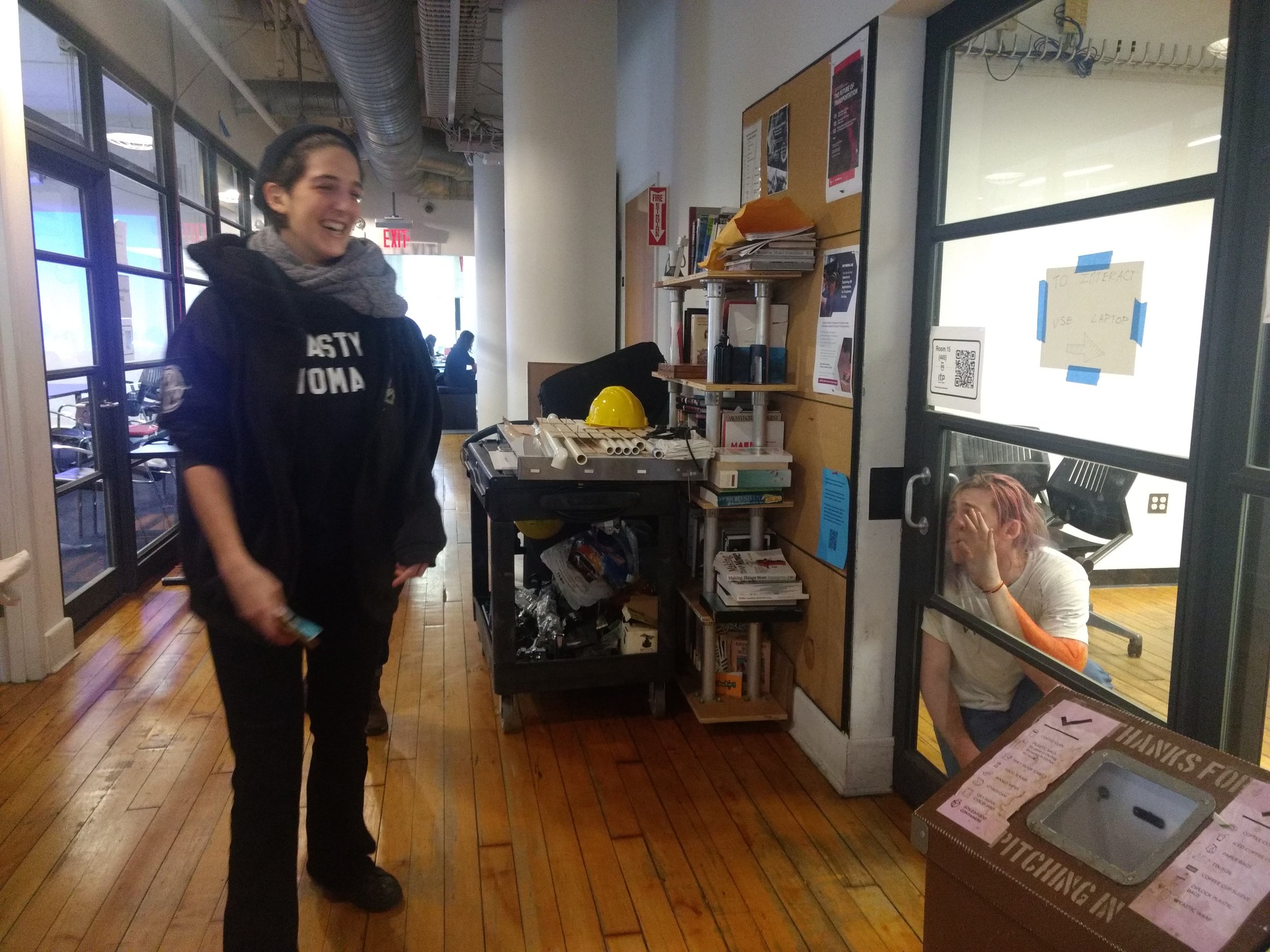
The premise was simple: I would be in a room surrounded by objects; a webcam would be streaming video, and I would have a laptop screen on which to receive instructions. Outside the room (in a spot I couldn’t see from anywhere in my room), there was another laptop displaying the webcam feed and a way to input commands. Since I didn’t have the ability to make a website people could go to individually, I figured a shared google doc was a simple low-tech option that would still demonstrate the function. I knew signage was going to be an issue since the laptop was removed from the actual site of performance, so my partner graciously offered to be an assistant and guide people if they were confused. I had 18 commands pre-written, nine continuous actions and nine discreet actions:

Continuous:

  1. Do an ab workout

  2. do jumping jacks

  3. stretch

  4. paint your body

  5. shock your arm

  6. juggle dildos

  7. balance on one foot

  8. flog yourself

  9. dab

Once per Command:

  1. Drink some water

  2. Eat a Cookie

  3. Suck on a Lemon

  4. Take an article of clothing off

  5. put an article of clothing on

  6. take a deep breath in/out

  7. do a line of Soylent

  8. slap yourself in the face

  9. stop (warning: will end performance)

I was really excited about most of these, and really worried about some…. Speaking of which, here’s me doing a line of soylent:

clip from the first playtest of Rhythm 0.0, a prototype performance art piece where participants anonymously and digitally send me commands at ITP, Nov. 5 2018, for Designing for Discomfort thanks to Hayley Pasley for assisting, and all those who had feedback on this demo!

Here’s the full list of commands I received.

The first one I gave myself at 1:20pm, and the “stop” command came at 2:00pm. You’ll notice that after about 10 minutes, people went off script and got creative.

  1. begin

  2. drink some water

  3. paint your body

  4. dab

  5. eat a cookie

  6. juggle dildos

  7. do a line of soylent

  8. count from 1 to 100 progressively, using a gesture and each number must be iterated with that same gesture but increasing the violence and energy of that gesture with each number.

  9. turn the lights off

  10. turn the lights on

  11. be gentle to yourself.

  12. when you do not feel like being gentle to yourself, yell the word ENOUGH.

  13. shut off the lights

  14. turn on the lights

  15. wear something that's not a hat as a hat

  16. hug yourself

  17. keep hugging yourself

  18. balance on one foot

  19. balance on one foot

  20. balance on the other foot

  21. put on ten hours of dogs barking and listen to that while you continue balancing on one foot and being gentle to yourself also- LIKE REALLY LOUD. obnoxiously loud.

  22. when this becomes unbearable, behave like a dog (revised after my assistant suggested that would never happen)

  23. when this becomes slightly unbearable, behave like a dog

  24. lie down and relax

  25. stare out the classroom window like an animal in a cage desperate for freedom (most fun one, see below)

  26. pretend to be like those fish in the abyssal zone of the ocean that have a light (angler fish) with your iphone. turn the room lights off.

  27. stop

The major takeaways for me:

  1. IT WASN’T ANONYMOUS!!!! Man! I spent so much time trying to figure out how to ensure people felt like they were anonymous by making it so that I couldn’t see or hear the people giving me instructions. But just because they were anonymous to me doesn’t mean they were anonymous!!! There was a huge issue I think with people feeling really self-conscious about what they were putting down, both because they didn’t want to pick a bad thing necessarily, and because once people went off script, they wanted to be more creative than the last person. But more than that, instead of people having their own private device, everyone had to share a laptop! So one person might be watched by a whole group of friends, like negative peer pressure! Beyond that, having my assistant there was great for troubleshooting, but terrible for inhibition. Definitely the most important confirmation of my initial hypotheses: People need to feel like no one will be able to tie them to whatever action I’m performing.

  2. Man, I knew signage was going to be an issue but it was even worse — I really should have focused more on the design of the input space. I had a sign up for people walking by the room that said “To interact use laptop ——>”, but even that sign should have been more obvious and inviting. Oh well, I don’t think that would be as much of an issue in my intended performance space anyway, since people will be congregating directly in front of a stage, instead of walking by a normal classroom and not looking in because why would you?

  3. Don’t trust camera rentals from the ER… I thought I had recorded my whole performance, but got two 4 second clips… Awesome.

  4. Having the ability for participants to write in their own instructions was really interesting and made for a lot of surprising, fun activity, but I don’t think I’ll keep that as an option moving forward. My assistant said there was this tone of “I have to write something more creative than the last person, since my classmates are judging my input” and I think that ultimately lead to less interactions overall. There was already a barrier to input from people being shy about choosing the commands, but when you add the additional anxiety from having to come up with something on their own, it made it so that there was less than 1 command per minute on average, which is not at all the frequency I had hoped for. I think it’s interesting that Abramovic offered finite options, but since they were objects in the control of participants, there were way more than 72 options. That’s not so much a possibility with my planned machine, so maybe I should consider other ways of giving control to users, other than the control of option-combos and frequency.

  5. DON’T SNORT SOYLENT. I have a (bad? genius?) habit of planning performance art pieces by imagining what do I NOT want to do, and then realizing if I don’t do that thing I’m not a real artist…. So when I thought, man, it would be so dumb to do a line of soylent, I immediately hated my brain. After doing a line in the performance, I literally thought I was going to die. I almost had a panic attack when I was getting lunch after the performance because I coughed up a cloud of soylent and convinced myself that my lungs were going to get infected or the moisture in the air was going to make the soylent clump up in my lungs. So I won’t be doing that again, but glad I did it once. I think.

View fullsize 45233628_1209107382561316_1197669033697083392_n.jpg
View fullsize 45413330_2065931946761626_436645633944715264_n.jpg
View fullsize 45441945_2210288709227228_6945020297258991616_n.jpg
View fullsize 45422939_334668270419525_7333921438358831104_n.jpg
View fullsize 45472286_310757673081699_2032289171967574016_n.jpg
View fullsize 45457789_333823380717056_2035962666085777408_n.jpg
View fullsize 45573677_1397733703692915_2796384379574681600_n.jpg
View fullsize 45623306_1972158943081793_4321476474101039104_n.jpg
View fullsize 45546549_972466209614713_8751531804504096768_n.jpg

Readings Response:

  • Drama Matters: What Do We Mean By Durational Performance?

    • Love the Abramovic quote about durational performance having the largest capacity to transform both audience and performer.

    • I do think there’s a lot of truth to the idea that durational performance reminds us what it is to live — there’s a lot of repetition and you sort of have to come in and out of attention. It’s not something that you can ever fully engage with, but you come in and out of it and by the end the sum of the parts makes something unique and transcendent, I think. I think there’s something special about watching someone spending a lot of time on one thing too; we spend so much of our effort managing our time and being acutely aware of how much time we have and how long things are going to take. So to watch someone simultaneously accept and reject that ingrained behavior by committing to doing something totally outside of survival-brain logic for so long, it really gives you pause. Even if the artist might not have spent as much time on the piece as, say, a sculptor who spent a year on a statue, there’s something about being present for the artist’s waste of time that makes it so much more real.

  • Marina Abramovic: A lecture on “The History of Long-Durational Work”

    • Love love the idea that durational performance is inherently a reaction to mortality and impermanence… Wow.

    • I remember reading in Abramovic’s memoir “Walk through Walls” that one of the factors that created the new medium of performance art in the 20th century was anti-capitalist artists desiring to produce media that couldn’t be commodified and sold, and I always think about that when discussing the ephemerality of performance art. I think that’s one of the most attractive things about the medium to me, that it’s a unique, once-in-a-lifetime experience for the artist and those present — even if it’s recorded, it’s not the same. There aren’t a whole lot of other types of art where that’s such a huge part of it, I don’t think, and makes each performance so important.

    • Fascinated by the idea that there’s a lot of baggage in the concept of an artist as a solitary hermit on a mountain, since I consider one of the focuses of my art to create community.

    • Laughing as I remember that I technically started a durational performance art piece in college called “August (Live)” that’s been on-going for the past 5 years.

  • Extended-Body: Interview with Stelarc

    • the bit about “I think metaphysically, in the past, we've considered the skin as surface, as interface. The skin has been a boundary for the soul, for the self, and simultaneously, a beginning to the world. Once technology stretches and pierces the skin, the skin as a barrier is erased.” reminds me of one of my favorite Alan Watts passages in “The Book”. He mentions how humans have this arbitrary distinction between the external and the internal, and how the skin isn’t a boundary, but rather the membrane that connects us to everything else in the world. Interesting to see the parallel in this context.

    • Oooooh love the idea that we now have to design bodies to match machines, instead of the other way around.

    • Man that stomach sculpture is gnarly.

categories: Designing for Discomfort
Wednesday 11.07.18
Posted by August Luhrs
 

Designing for Discomfort Week 8: Truth or Dare

Reading Response:

  • Brenda Romero — Gaming for Understanding

    • Amazing, love the idea of tricking kids into understanding complex topics by having them play games.

    • Really inspiring. I wonder how to get people to play a game like this though — the little girl didn’t know what she was getting into, I imagine it would be much harder to get a school-aged kid excited to play a game about slavery unless you misled them.

    • It also risks trivializing hugely traumatic events. I would argue against this, but I could see a lot of people getting upset over trying to make something like the holocaust “fun”, even though that’s more of a misconception about what a “game” is though. Is it still a game if it’s not fun? A game like “That Dragon, Cancer”, that’s not supposed to be fun, and I’d argue that’s one of the most important video games ever made.

  • Ida Benedetto — Patterns of Transformation

    • I’m obsessed with redesigning funerals, this hits close to home.

    • I really like the idea that there’s a lot in common between people who go to sex parties, wilderness guides, and avant-garde morticians. Makes a lot of sense.

    • Definitely vibe with the idea that there can’t be transformation without risk. There’s a lot of Burning Man here… which coincidentally has a lot of wilderness, sex parties, and funerals. Burning Man also stresses active participation.

    • A little confused on the difference between embraced and conditioned magic circles.

Truth or Dare Redesign: Innie or Outie

Instructions: Two or more players, traditional truth or dare set up, but one at a time players are instead asked “Innie or Outie?” If “Innie”, the asker designates an act of self-care or otherwise positive action for the individual to take themselves, if “outie” the asker designates a positive action for the whole group to take at once.

Comments/Questions from playtest:

  • Should the task be written down before the person selects innie or outie? Because as an asker, I felt a much different mindset once I heard “outie” and realized I would be participating in this myself.

  • Should we explicitly say the command should be positive? Or if adhering to the previous point of writing down the command before, would people typically choose something positive anyway, since they risk themselves having to do it?

  • Suzanne mentioned it didn’t feel as though we were connecting to each other as much as we might in a traditional Truth or Dare game, and I wonder if that’s because there’s no shared suffering. If we’re all just feeling good then there’s nothing to bond over?

categories: Designing for Discomfort
Wednesday 10.31.18
Posted by August Luhrs
 

Powered by Squarespace.